

Chief Anette Sanford, Indigenous environmental leader from Dominica, to receive Seacology Prize
We are excited to announce that Anette Thomas Sanford, chief of the Kalinago territory on the Caribbean island nation of Dominica, will receive the 2026 Seacology Prize!
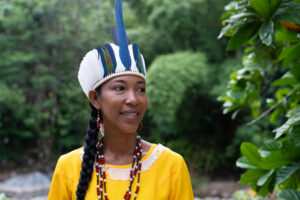
Chief Sanford, also known by her Kalinago name, Arkuenani, has long been a leading voice for the Kalinago people, and an ardent advocate for the ecosystems that have sustained them for centuries. Recently, she has emerged as a leader in the fight against a controversial mining project that threatens an important watershed, Indigenous rights, and public health.
A nurse by training, Sanford was elected as the country’s first female Kalinago senator in 2020. Two years later, she was elected to lead the semi-autonomous Kalinago Territory, becoming the first woman to serve as chief in the community’s recorded history.
A resilient people
The Kalinago are the last Indigenous society of the Caribbean to maintain their institutions in their ancestral homeland. European colonists displaced most of the Kalinago, and their remaining communities on Dominica and Saint Vincent faced repression and violence. On Dominica, they took refuge in the island’s mountainous east, which the colonists struggled to penetrate. A network of ancient trails through this inhospitable landscape supported the Kalinago people’s survival and helped enslaved Africans, with Kalinago help, to escape.
Today, a 3,700-acre territory in these coastal mountains is home to the world’s largest Kalinago population, about 3,000 residents. As chief, Sanford has promoted environmental stewardship in the territory and beyond.
“The Kalinago people were always protectors of the land. We are one with nature,” she said. “It’s normal for us to plant trees, to try to preserve our rivers, because we depend on these natural resources to survive.”
Dominica's mountainous east coast is now home to the world's largest remaining Kalinago community.
The area's rivers have deep cultural significance for the Kalinago.
Confronting today’s threats
Kalinago sovereignty is now legally recognized, but the people face serious challenges: poverty, political marginalization, misrepresentation by outsiders, and environmental destruction. Recently, a quarry was dug at Deux Branches, just upstream from their territory, endangering public health and a watershed that the Kalinago have long considered sacred. People swimming in the river after the excavation began have been hospitalized for suspected reactions to the pollution.
Working with grassroots movement Save Deux Branches, Chief Sanford has helped organize protests and draw attention to the lack of transparency and public input around the operation. The group is mounting a court challenge to the mining permit, which they argue was issued illegally.
“At some personal risk to her reputation and safety, she just stood up and said, ‘No, this is not going to happen,’” said Seacology Executive Director Duane Silverstein. “She’s a valiant fighter in the tradition of Seacology Prize winners.”
A large quarry at Deux Branches threatens the health of a watershed that the Kalinago depend on.
Chief Sanford and local conservation movement Save Deux Branches have led opposition to the project.
New chapters in an ancient story
Sanford has worked diligently to improve health and economic conditions within the territory and preserve the Kalinago people’s unique identity. She cofounded Kibe’kuati (“That Which Multiplies”), an NGO that improves access to clean water, supports sustainable businesses, helps promote Kalinago culture, and provides services for victims of gender-based violence.
“When Chief Sanford came in and I saw her plans as the first woman coming forward to represent us, I felt proud,” said Teddy Thomas, a member of the Kalinago Council. “She was continually encouraging people, educating people, and looking for different projects which will bring the Kalinago people forward as one family.”
One of these projects is a new coastal trail through the Kalinago Territory, an initiative that will protect important forest and help the community benefit from growing ecotourism in Dominica. Seacology funded trail development, training for guides, restoration of native trees and medicinal plants along the route, and a new visitors center.
The modern trail follows routes through Dominica’s unspoiled wilderness that the ancestors of today’s Kalinago once walked. The trailhead is at L’Escalier Tête Chien, an important site in local mythology. Newly certified guides will navigate visitors safely through the steep, densely forested terrain and explain the deep significance of the land that the trail traverses. The community hopes this will help foster a greater, more accurate public understanding of Kalinago culture and history.
The new trail starting from L’Escalier Tête Chien intersects with ancient routes through the forest that helped the Kalinago community survive on Dominica.
In June, members of the Kalinago community completed their training to become certified trail guides.
We will present the 2026 Seacology Prize to Chief Anette Sanford on Monday, October 12, Indigenous People’s Day. Click below to order your free tickets to the prize ceremony in Berkeley, California. As always, the Seacology Prize Ceremony is open to the public. Space is limited, so we encourage you to reserve your seat early. For those unable to attend in person, it will also be streamed live on YouTube.